Ideas / Illustrative concept
A family history publishing service
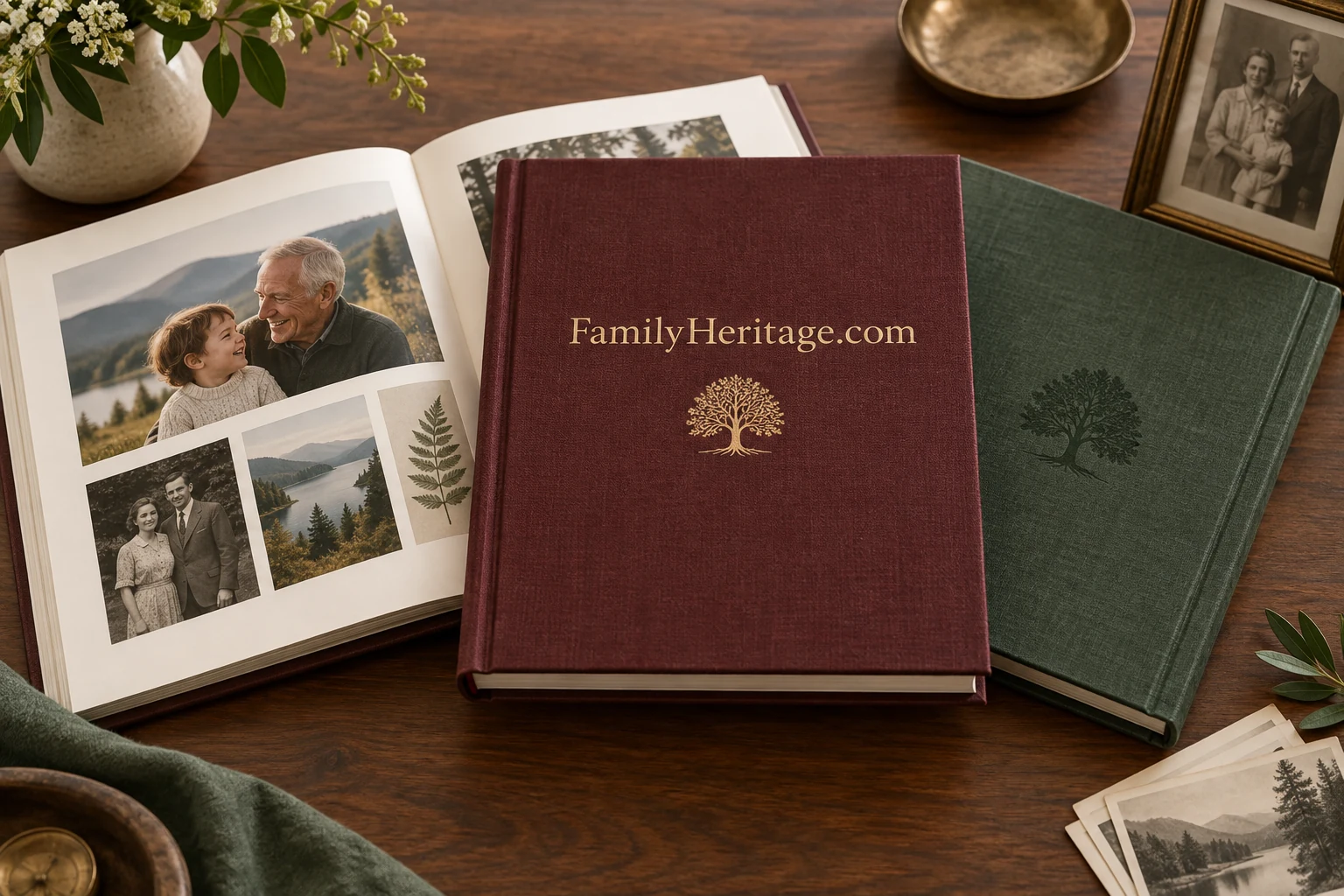
A family book can give scattered material a beginning, a middle and a place on the shelf. The customer may already have photographs and recollections but need help choosing, arranging and explaining them. FamilyHeritage.com could house a publishing service that turns a defined collection into a readable book, with an editorial process the family can follow.
This is an illustrative business direction. The first offer could focus on a modest book about one household, one place or one period. A limited scope would help the editor produce a coherent result and help the family understand what to gather. An attempt to cover every branch of a family in the first project can make approval and completion much harder.
Define the book before collecting everything
A useful intake conversation asks who will read the book and what that reader should understand by the last page. A book for grandchildren may need short explanations of places and relationships that older relatives take for granted. A reunion edition may emphasize names, photographs and a clear guide to the people pictured. Those choices affect both the writing and the page design.
The opening package could specify an approximate page range, an image allowance, a set number of interviews or written submissions and two proof rounds. The editor would explain what happens if the family adds a new chapter after the layout begins. A written scope can preserve room for collaboration while preventing every late discovery from restarting the whole project.
For example, a family might choose to document forty years in one house. The chapters could move through the kitchen, the garden, celebrations and the people who came to visit. A floor plan drawn from memory could be included as an explicitly labeled recollection. The narrow subject gives each contributor a prompt and makes it easier to decide which photographs belong.
Make context visible on the page
Captions often carry information a reader cannot recover from the image alone. A good submission form would ask who is pictured, where the photograph was taken, the best available date and who supplied those details. The editor should preserve uncertainty in plain language. An approximate year is more useful than a precise date invented to fill an empty field.
The source of a story also matters. A passage recalled by one relative can be attributed to that person. A document can be identified by its title and location in the family's collection. The book should help readers distinguish a remembered conversation from a record made at the time. This need not turn a personal book into a scholarly volume; a short note may be enough.
The Library of Congress guidance on digitization gives useful handling considerations when preparing physical material for imaging. A publisher should establish how originals are supplied, transported and returned. Delicate albums may call for a different method from loose modern prints, and difficult material may need specialist help.
Give the family a workable review process
The project needs one person who can consolidate comments. If eight relatives send competing versions of a caption to the designer, the team can lose track of which decision is final. A coordinator can collect disagreements, ask the relevant person and return a single list of changes. The publisher should still make it clear who has authority to approve the book.
A content review should happen before the final design proof. At that stage, readers check names, dates, story selection and permissions. Later, the layout proof is for checking the way that agreed material appears on the page. Separating the two passes helps people focus and makes the schedule easier to explain.
Where recorded interviews supply the text, the publisher should establish how the speaker will review their contribution. The Oral History Association's core principles describe consent and participation as continuing parts of the work. A book project should make its own intended use clear, particularly if the family later considers wider distribution.
Build a production offer people can picture
The business would need editing, design, image preparation and print production capabilities. These could be delivered by a small team or coordinated through specialist partners. Either way, the customer needs one clear point of contact and a realistic account of what is included. A beautiful sample is useful only if the production process can reproduce its quality consistently.
A physical proof can reveal issues that are easy to miss on a screen. Small captions, dark photographs and narrow margins may need adjustment. The operator should decide when that proof is produced, who reviews it and how changes affect the schedule. Shipping, replacement copies and reprints also belong in the operating plan.
The handover could include the agreed number of books and a digital reading copy. The publisher should explain whether editable design files are included and how a later reprint would work. Families may want to add another chapter in a few years; a clear record of the project's assets and permissions makes that future conversation easier.
Start with a channel close to the project
Professional photo organizers offer one plausible route to customers. Their clients may have just completed the work of sorting a collection and be ready to choose a set of images for a book. A publisher could test a referral arrangement with a small project type, a sample and a shared intake checklist. The first goal would be to learn which families have both suitable material and a clear reason to finish.
A buyer considering this model can use an inquiry about FamilyHeritage.com to describe its editorial team, production experience or planned first package. The domain could support a focused publishing brand while leaving room for later formats. The next step is to make one proposed book offer clear enough that a customer can understand the work, the decisions and the finished object.